Tell us what products you need, your target market, estimated quantities, required specifications, packaging requirements, and any documentation your company requires.
Still Looking for a Reliable Disposable PPE Supplier?
Tell us what disposable PPE you need, including specifications, quantity, target market, and OEM needs. We’ll review it and recommend suitable options.
Contact Our Team
Tell us what products you need, your target market, estimated quantities, required specifications, packaging requirements, and any documentation your company requires.
Have a PPE Product Requirement ? Talk to Our Specialists
Get practical guidance on disposable PPE specifications, materials, sizing, packaging, private labeling, documentation, and bulk production requirements.
A surgical mask can pass every lab test and still be unsellable in the United States if its carton says the wrong thing. In the US, a mask marketed as a surgical or medical mask is a regulated medical device, and its proposed labeling is part of what the FDA reviews. For distributors, importers, and private-label brands, the practical questions are specific. Which statements must appear? Which performance claims are safe to print? Where does FDA authority stop and NIOSH authority begin? This guide covers the main US labeling requirements for medical and surgical face masks, how ASTM F2100 claims fit in, how masks differ from respirators and non-medical face coverings, and what to verify before you approve artwork or place an order.
Who Regulates Medical and Surgical Face Masks in the US?
The FDA regulates surgical masks as Class II medical devices. Under 21 CFR 878.4040, surgical masks and surgical gowns are classified as Class II (special controls), while other surgical apparel falls into Class I. The regulation exempts surgical N95 respirators and N95 filtering facepiece respirators from 510(k) notification only under stated conditions, one of which is NIOSH approval. Ordinary surgical masks are not covered by that exemption. FDA’s surgical mask guidance for 510(k) submissions%5D-Submissions–Guidance-for-Industry-and-FDA-(PDF-Version).pdf) covers product codes FXX (surgical mask) and MSH (surgical N95 respirator).
Two other bodies matter. As FDA’s face mask and respirator page explains, NIOSH also regulates N95 respirators, and OSHA enforces workplace rules such as respirator use. Customs rules for country-of-origin marking are separate again, so confirm those with your customs broker.
What Must Appear on a Surgical Mask Label?
A compliant surgical mask label must carry the device’s identity and intended use, the name and place of business of the responsible company, English-language text, and a unique device identifier (UDI) unless an exception applies. The binding rules sit in 21 CFR Part 801. FDA’s mask guidance is nonbinding, but it states that final labeling must comply with Part 801 before the device enters interstate commerce.
The table below turns those requirements into questions a buyer can ask when reviewing a sample or artwork proof.
Label element
Regulatory basis
Audit question for your supplier
Intended use and mask type
FDA guidance recommends stating intended use and whether the mask is an isolation, procedure, or dental mask
Does the wording match the cleared indications for use?
Single-use status
FDA guidance recommends stating whether the device is reusable or single-use
Is “single use” or “disposable” stated clearly on the box?
If the named company did not manufacture the mask, does the label say “Manufactured for” or “Distributed by”?
English text
21 CFR 801.15 requires label statements to appear in English, with limited symbol options
Is every required statement in English, and is any symbol explained or covered by an FDA-recognized standard?
UDI
21 CFR 801.20 and Part 830
Is the UDI shown in plain text and machine-readable form?
Lot or expiration data
Part of the production identifier when included in the UDI
Do inner box, outer carton, and invoice show the same lot and date?
Flammability warning
FDA guidance suggests a warning for Class 3 flammability masks
Is flammability class documented in the test report?
Performance claims (for example ASTM F2100 level)
Must be supported by test data and consistent with the clearance
Does the test report cover the exact construction being shipped?
The FDA guidance also notes that final labeling for prescription devices must meet 21 CFR 801.109. Surgical masks are generally sold over the counter, but confirm the classification stated in your supplier’s clearance rather than assuming it.
How Do UDI and Lot Traceability Work for Masks?
A UDI has two parts. According to FDA’s UDI basics page, the device identifier identifies the labeler and the specific version or model, while the production identifier can carry the lot or batch number, serial number, expiration date, or manufacture date. The labeler must show the UDI in easily readable plain text and in a machine-readable form, and dates must follow the YYYY-MM-DD format. Labelers also submit device information to the Global Unique Device Identification Database (GUDID), which the public can search through AccessGUDID.
The labeler is usually the manufacturer, but FDA’s definition also reaches relabelers and repackagers. Adding a distributor’s name and contact details without changing anything else does not make a company a labeler. A private-label program that changes the label more than that can shift responsibilities, so settle who acts as labeler before artwork is finalized. The UDI rule also contains limited exceptions. Ask the supplier which one it relies on, if any, rather than accepting “not required.”
Do ASTM F2100 Levels Belong on the Label?
Many surgical mask cartons show “ASTM F2100 Level 1,” “Level 2,” or “Level 3.” The claim is common, and it is easy to misread. ASTM F2100 is a material performance specification. According to ASTM’s published abstract for F2100, it classifies medical face mask materials by bacterial filtration efficiency, differential pressure, sub-micron particulate filtration efficiency, resistance to synthetic blood penetration, and flammability. It does not address all aspects of mask design, does not evaluate how well a design performs as a barrier, and does not cover regulated respiratory protection. The abstract shown is for the F2100-21 revision; confirm which revision your supplier tested against.
Two points follow for buyers.
An ASTM level is not proof of FDA clearance. The standard describes material performance. Clearance is a separate FDA determination of substantial equivalence for a specific device. A carton can carry a Level 3 claim and still lack a legal basis to be marketed as a surgical mask.
A higher level is not automatically the better purchase. The levels differ in fluid resistance, filtration, and breathing resistance, so the right level depends on the setting. FDA’s guidance recommends Class 1 or Class 2 flammability materials for masks used in the operating room, and it suggests a warning when a mask meets only Class 3 flammability. A clinic doing low-splash procedures and an operating room have different needs. Match the level to your customers’ exposure, then check that the lab report supports the level printed on the box. Because the standard sets different numeric limits per level and is revised periodically, read the current revision before writing specification sheets.
How Do Surgical Masks, Respirators, and General Face Masks Differ?
Labeling goes wrong most often where product categories blur. The same factory may make a surgical mask, a general-purpose face mask, and a KN95-style product, and each carries different claims.
Product type
Main US framework
Labeling focus
Red flags
Surgical or medical mask
FDA Class II, 21 CFR 878.4040, product code FXX
Mask type, intended use, performance claims consistent with the clearance, UDI
No traceable 510(k) number; NIOSH or N95 wording on a loose-fit mask
Surgical N95 respirator
NIOSH approval plus FDA classification (product code MSH)
NIOSH marks without a matching entry on NIOSH’s list
Face mask (non-surgical)
FDA describes these as source control, not personal protective equipment
Wording must not imply surgical or infection-prevention performance
“Medical grade” or fluid-resistance claims without clearance
Barrier face covering
FDA references ASTM F3502-21
Claims limited to source control and a degree of particulate filtration
Claims that substitute for a respirator or surgical mask
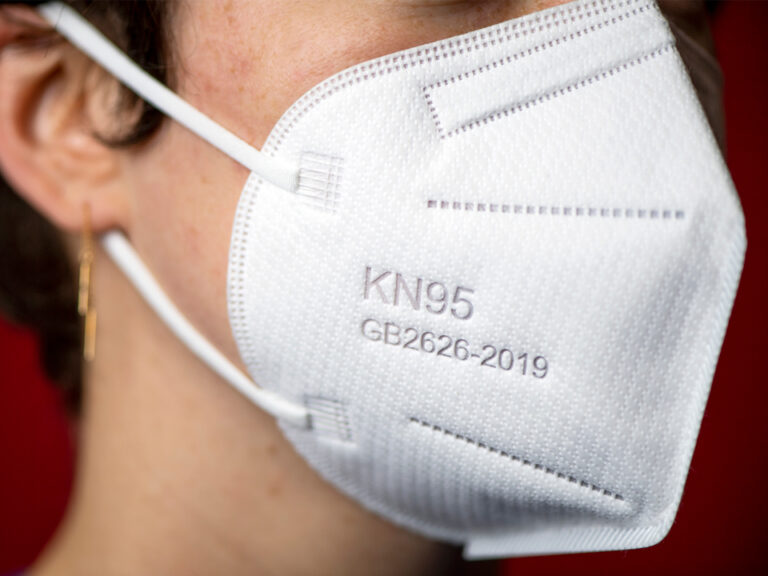
KN95-style products
Foreign-standard designation, not a NIOSH approval class
Must not claim NIOSH approval
Misuse of NIOSH certification marks
FDA’s mask page states that a face mask may or may not meet any fluid barrier or filtration level, and that not all face masks are regulated as surgical masks. It describes a surgical mask as loose-fitting and disposable, with edges that are not designed to seal around the nose and mouth.
On the respirator side, NIOSH’s guidance on counterfeit and misrepresented respirators says only respirators evaluated by NIOSH are NIOSH Approved, and that products misusing its registered certification marks or falsely sold as approved are misrepresented. It also says buyers should confirm that the model name and approval number match NIOSH’s Certified Equipment List. Apply the same check to any N95-style product in your catalog.
What Changed After the COVID-19 Emergency?
Some labeling and inventory practices from 2020 to 2023 no longer apply. According to FDA’s COVID-19 face mask and respirator FAQ page, the COVID-19 public health emergency expired on May 11, 2023, and the enforcement policy guidances listed in FDA’s transition plan are no longer in effect. The same page, in an entry dated August 11, 2026, says the HHS Secretary determined on June 29, 2026 that circumstances no longer justify emergency use authorization for personal respiratory protective devices and medical devices, with the declarations terminating effective December 26, 2026.
For buyers, the consequence is straightforward. Stock whose legal basis was an emergency authorization or a pandemic-era enforcement policy needs a fresh review. Do not rely on legacy cartons or older certificates. Ask whether the product has its own 510(k) clearance, and read FDA’s page directly before you plan a sell-through of older inventory.
Which Labeling Mistakes Delay Distribution?
The following issues follow directly from the rules above. They are risk areas for any importer, not a measured frequency.
Claims that outrun the clearance. Terms such as “medical grade,” “fluid resistant,” or “bacteria barrier” need support in the cleared indications and test data.
Standards printed without reports. An ASTM level on the box without a matching test report is a claim you cannot defend.
Respirator language on masks. N95, NIOSH, or “respirator” wording on a loose-fit surgical mask invites a misrepresentation problem.
Non-English labels. Under 21 CFR 801.15, required information must appear in English, and label-space exemptions are unavailable when the shortage comes from foreign-language text.
Missing or vague responsible-party statements. If the company named on the box did not make the mask, the label must say how it relates to the device.
Mismatched traceability data. Different lot numbers or dates on the inner box, carton, and invoice undermine recall readiness.
Legacy emergency-era wording. Packaging that references an expired emergency pathway should be reviewed before shipment.
Consider an illustrative example, not a real customer case. A distributor approves artwork for a three-layer mask that shows “Level 2” and the distributor’s own name. The supplier’s test report covers a different nonwoven construction, and the carton never says “Distributed by.” Each gap is small. Together they mean the distributor cannot show that the label matches the product it is actually selling.
Does the Same Claim Discipline Apply to Other Disposable Products?
Yes, with different rules. The principle that intended use and claims drive regulatory treatment is not limited to masks, so a buyer sourcing a mixed disposable line should handle each SKU separately.
General-purpose covers are the simplest case. Items such as disposable nonwoven flat sheets for treatment tables, nonwoven elastic bed covers, and the disposable flat sheet roll are described by the supplier as covers for beds and treatment surfaces, offered in materials such as PP, SMS, and laminated options. Whether any given sheet or cover is a regulated medical device depends on its intended use and the claims made for it, so keep the label and marketing copy aligned with the use you can support, and take regulatory advice when a product is positioned for clinical procedures.
Sterile claims add another layer. The EO-sterilized adhesive PP/PE drapes are listed with individual packaging and EO sterilization. A sterile claim means you should ask the supplier for the sterilization method, validation records, and the label statements that go with them. A non-sterile box does not need them. Do not carry sterile wording from one SKU to another.
What Should Buyers Verify Before Approving Mask Labels or Requesting a Quote?
Verify the paperwork before you approve artwork, because corrections after printing cost time and cartons. Use this sequence.
Confirm FDA status. Ask for the 510(k) number and product code, then check the record in FDA’s 510(k) database. Make sure the applicant, device name, and indications match what you are buying.
Review artwork against the clearance. Every claim on the carton should trace to the cleared indications or a test report.
Request the test report for the shipped construction. It should cover fluid resistance, filtration, differential pressure, and flammability for the stated ASTM level, and it should name the standard revision.
Check the UDI and the GUDID record. Look the device identifier up in AccessGUDID.
Verify any NIOSH claim. Match the model and approval number to NIOSH’s Certified Equipment List.
Agree on labeler responsibility if you want private-label or distributor-branded packaging.
Inspect a production sample, not only a pre-production one, for English text, lot, and date consistency.
When you send a request for quotation, include the mask type and intended use, the target ASTM level, ear-loop or tie-on style, color and printing, private-label requirements, order quantity, packaging format, labeling language, and destination market. For mixed shipments, add per-SKU documentation requests. If you also buy disposable stretcher cot sheets or disposable transfer sheets with handling straps from the same supplier, ask for a separate specification and label proof for each, rather than one shared compliance statement.
This guide is informational and does not replace advice from a regulatory professional. Check current FDA requirements before you commit to labeling or inventory decisions.
Frequently Asked Questions
Do surgical masks need FDA clearance to be sold in the US?
Generally yes. Surgical masks are Class II devices under 21 CFR 878.4040, and FDA’s guidance addresses 510(k) premarket notification for them. The 510(k) exemption in the regulation applies to certain N95 respirators under stated conditions, including NIOSH approval, not to ordinary surgical masks.
What information must be printed on a surgical mask box?
At minimum, the label needs the device’s identity and intended use, the manufacturer, packer, or distributor name and place of business, English-language required text, and a UDI unless an exception applies. FDA guidance also recommends stating mask type and single-use status.
Does an ASTM F2100 Level 3 label mean the mask is FDA approved?
No. ASTM F2100 classifies the performance of mask materials. It does not clear a device for sale. The FDA’s clearance process is separate, so a Level 3 claim needs both test data and a matching 510(k) to support it.
Can a distributor put its own brand name on a surgical mask?
It can in many cases, but responsibilities change. The label must show how the named company relates to the product, such as “Distributed by,” and a labeler role may apply if the label is changed. Settle this in writing with the supplier before artwork is printed.
Can a non-medical face mask be sold with surgical or medical claims?
Not safely. FDA describes general face masks as source control rather than personal protective equipment, and notes that they may not meet fluid barrier or filtration levels. Claims shape regulatory status, so avoid medical wording unless the product has the appropriate authorization.
Do COVID-era emergency authorizations still cover masks?
Only for a limited time. FDA states that existing EUAs remain in effect for now, but HHS determined in June 2026 that the declarations for respiratory protective devices and medical devices will terminate effective December 26, 2026. Verify each product’s current legal basis.
How can I verify a surgical mask’s FDA status?
Ask the supplier for the 510(k) number, then search FDA’s 510(k) database and confirm the applicant, device name, and indications match the product. Check the UDI device identifier in AccessGUDID, and verify any NIOSH approval claim against NIOSH’s Certified Equipment List.