Tell us what products you need, your target market, estimated quantities, required specifications, packaging requirements, and any documentation your company requires.
Still Looking for a Reliable Disposable PPE Supplier?
Tell us what disposable PPE you need, including specifications, quantity, target market, and OEM needs. We’ll review it and recommend suitable options.
Contact Our Team
Tell us what products you need, your target market, estimated quantities, required specifications, packaging requirements, and any documentation your company requires.
Have a PPE Product Requirement ? Talk to Our Specialists
Get practical guidance on disposable PPE specifications, materials, sizing, packaging, private labeling, documentation, and bulk production requirements.
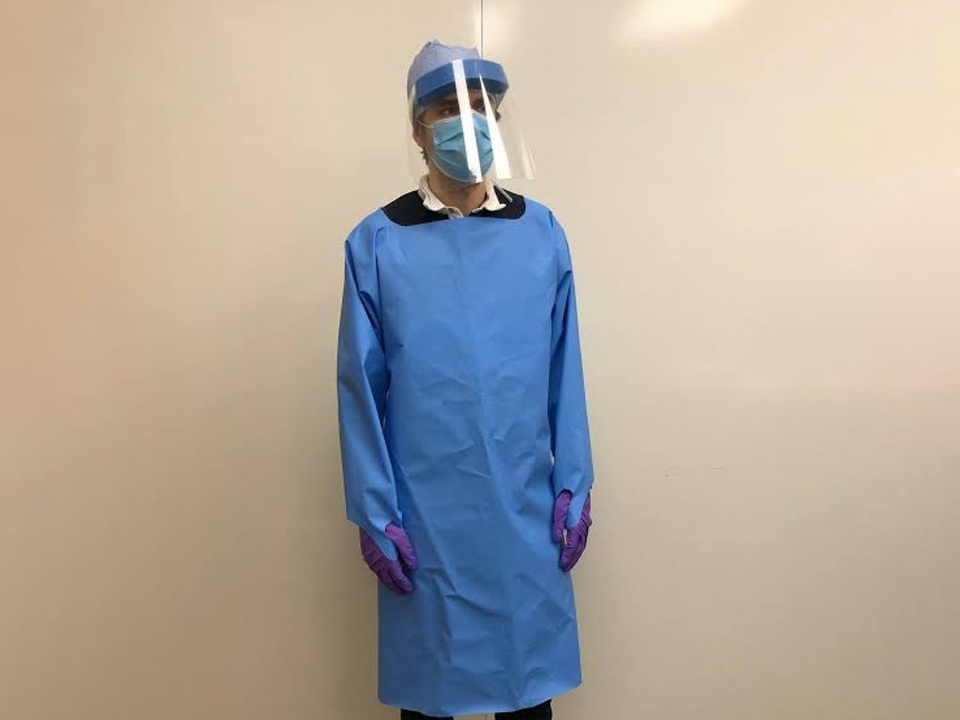
GSM, or grams per square metre, tells a buyer how much a fabric weighs. An AAMI level tells a buyer how a gown performed against a defined liquid challenge. The two numbers answer different questions, and ANSI/AAMI PB70 classifies gowns by test results, not by fabric weight. A quote for a “45 gsm SMS isolation gown” therefore leaves the barrier question open, however solid the fabric feels in the hand. This article explains what GSM does and does not measure, what each PB70 level requires, and how to turn a vague “Level 3 quality” claim into documents you can check before placing an order. It is written for procurement managers, distributors, importers, and private-label buyers who source disposable isolation gowns.
What Does GSM Measure in an Isolation Gown Fabric?
GSM is the mass of fabric per square metre. In a nonwoven gown it is the combined weight of every layer. That means the spunbond and meltblown polypropylene layers in SMS, or a nonwoven layer plus a PE film in PP+PE and SMS+PE, along with any binder or finish.
That makes GSM useful for a few things: material cost, hand feel, opacity, shipping weight, and checking that one production lot matches the last. It cannot tell you how the fibres are arranged, whether a continuous film is present, how the surface was treated, or how the seams were made. Two fabrics at the same GSM can land on opposite sides of a pass/fail line, because weight can come from coarse fibre that adds mass without closing the pore structure.
What Does ANSI/AAMI PB70 Actually Require?
According to CDC NIOSH’s standards and specifications page for protective clothing, ANSI/AAMI PB70 classifies protective apparel, including surgical and isolation gowns, by liquid barrier performance. It defines four levels, and Level 1 is the lowest while Level 4 is the highest. The classification table published by NIOSH (based on the 2012 edition) is summarized below.
PB70 level
Test method(s)
Liquid challenge
Pass criterion
What the result means
Level 1
AATCC 42 impact penetration
Water
4.5 g or less
Minimal water resistance
Level 2
AATCC 42 and AATCC 127 hydrostatic pressure
Water
1.0 g or less; 20 cm or more
Low water resistance
Level 3
AATCC 42 and AATCC 127 hydrostatic pressure
Water
1.0 g or less; 50 cm or more
Moderate water resistance
Level 4
ASTM F1671 viral penetration (gowns)
Bacteriophage Phi-X174
No penetration at 2 psi (13.8 kPa)
Blood and viral penetration resistance
Three points matter for buyers.
No row contains a fabric weight. Every criterion is a test outcome. A gown earns a level by passing the tests, not by reaching a GSM.
Levels 1–3 and Level 4 are different kinds of evidence. NIOSH notes that Levels 1–3 use only water as the challenge, and that blood penetrates fabrics more readily than water because of its lower surface tension. It states that no correlation can be made between the AATCC water tests and the ASTM F1671 viral penetration test. Only Level 4 gowns are considered impermeable to viral penetration by that method.
Editions and labeling differ. The FDA’s Recognized Consensus Standards entry for ANSI/AAMI PB70:2022 shows partial recognition, entered 05/29/2023. The same entry states that FDA guidance requires the level of liquid barrier protection to be clearly identified in labeling, and that FDA treats procedure gowns claiming moderate to high barrier as surgical gowns under 21 CFR 878.4040. When a supplier cites PB70, ask which edition the test report follows.
Why Does a Heavier Fabric Not Guarantee a Higher Barrier Level?
Fabric weight is an input. Barrier performance is an outcome that depends on construction, finishing, seams, and the finished garment design. Four mechanisms break the link between GSM and level.
Construction matters more than mass
An SMS fabric, a PP+PE film laminate, and a microporous fabric resist liquid in different ways. One manufacturer technical guide, AAMI Level 4 Gown Materials: Barrier Protection, Breathability, and Fabric Selection, makes the same point from the supplier side. Material names such as PP+PE, SMS, or CPE do not establish a passing result, so the exact composite needs its own evidence. Film-based constructions can raise liquid resistance, but they also affect breathability and wearer comfort. A heavier film laminate is not automatically the better purchase for a long shift.
Seams belong to the claim
NIOSH explains that, for isolation gowns, the whole garment is treated as a critical zone. The entire gown, including the seams but excluding cuffs, hems, and bindings, must achieve the claimed barrier performance. A report on flat fabric alone does not show that the sewn, ultrasonically bonded, or taped seams of the finished gown meet the same level.
Open-back designs cannot be rated
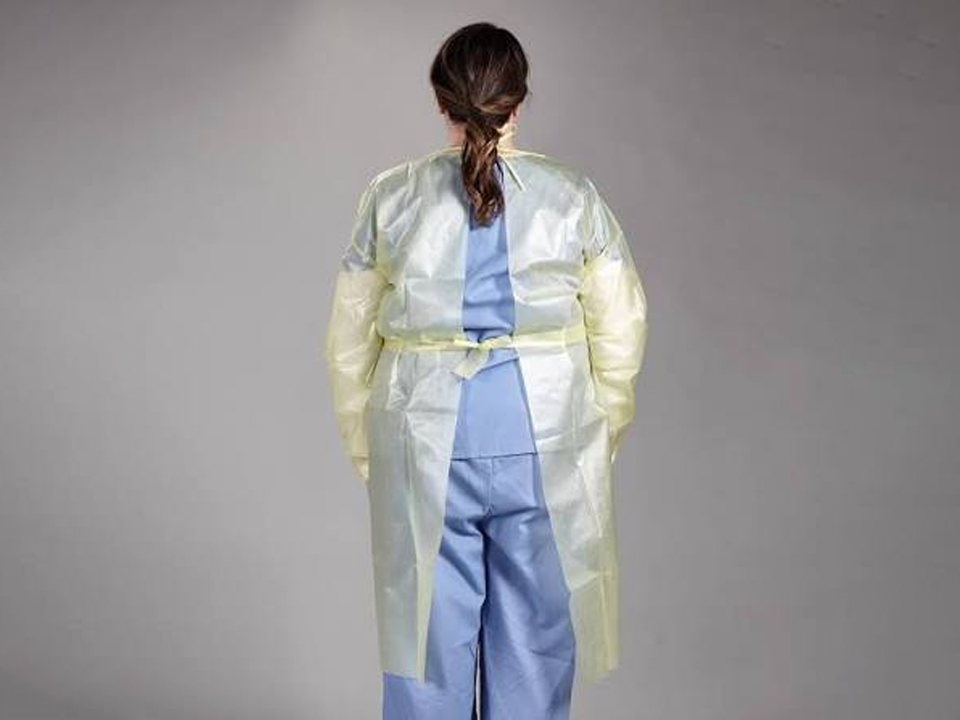
According to the same NIOSH page, open-backed isolation gowns do not meet the critical-zone parameters and therefore cannot be rated. A lightweight open-back gown can serve a legitimate low-risk purpose, but it should not be quoted with a PB70 level.
Surgical and isolation gowns are not interchangeable
NIOSH points out that a surgical gown’s critical zone covers at least the front panel and lower sleeves, and the back can be non-protective. Using a surgical gown in an isolation setting may therefore not provide appropriate protection. Buyers should define the gown type before comparing levels.
What Does Each Number on a Quote Actually Tell You?
Use the table below to separate descriptive specifications from verified performance.
What the quote says
What it tells you
What it does not tell you
What to ask for
“45 gsm”
Fabric mass per area
Barrier level, seam performance
GSM tolerance, plus the test report for the finished gown
“SMS” or “PP+PE”
Material family
Whether this construction passes any PB70 level
Layer structure and report for the exact composite
“Fluid resistant” or “waterproof”
A general marketing description
Which test, which challenge, which pass result
The named test method and result
“Level 3 quality” or “Level 3 equivalent”
Nothing verifiable
Whether the gown was ever tested
Report showing AATCC 42 and AATCC 127 results
Hydrostatic head figure only
Resistance to water pressure (AATCC 127)
Impact penetration (AATCC 42) or viral penetration
Both AATCC 42 and AATCC 127 for Level 2 or 3
AAMI level printed on the label
The supplier’s claim
Whether a current report supports it
Report that matches the model, material, and seams
ASTM F1671 report
Viral penetration result under the method
Coverage of every seam and critical zone
Report scope, pressure, and specimen description
An illustrative comparison
The following is a hypothetical scenario, not a real customer case. Supplier A quotes a 35 gsm gown and attaches a laboratory report listing AATCC 42 and AATCC 127 results for the finished gown, seams included. Supplier B quotes a 55 gsm gown and describes it as “Level 3 quality” with no report. Supplier B’s gown costs more in material and ships heavier, yet the buyer holds no evidence of its barrier performance. Supplier A’s lighter gown comes with something the buyer can verify, and the buyer can then judge fit, comfort, and price on the same footing.
How Should Buyers Read Gown Product Pages and Catalog Specs?
Catalog pages for configurable gowns usually describe what a factory can make, not a single tested product. The disposable isolation gown for wholesale PPE procurement page lists PP nonwoven, PP+PE, SMS, or SMS+PE at 16–65 gsm, with multiple sleeve, cuff, and back-neck closure options. A range that wide covers several constructions that would perform very differently. The description and specification table I reviewed do not state a PB70 level, which is reasonable for a configurable item, since the level has to be defined and tested per project. A buyer who needs a level should name it in the RFQ and request a report for the exact configuration.
Other gown categories follow the same logic:
The disposable microporous chemo gown page lists a 52 g microporous fabric with blue taped seams, thumb-loop cuffs, and a non-sterile or EO-sterilized option. Taped seams are relevant to barrier claims, but a PB70 level says nothing about drug permeation. If chemotherapy protection is the purpose, ask what test method and which agents support that claim.
The disposable nonwoven kimono gown page lists PP, SMS, or spunlace at 30–65 gsm for spa, salon, and hygiene programs. In that application GSM mostly controls hand feel, opacity, and cost, and a PB70 barrier claim is not the relevant lens.
When Does GSM Still Belong in the Specification?
GSM remains a legitimate specification when it is used for what it measures. The conventional assumption deserving qualification is that a heavier gown is a safer gown. In practice, a lighter gown with a documented, product-specific test result can be the better choice for both protection evidence and comfort, while a heavier gown without documentation offers only an assumption.
Use GSM for these purposes:
Lot-to-lot consistency. Specify a nominal GSM with a stated tolerance, and verify it on incoming inspection. A drift in weight can signal a change in layers or process.
Cost and freight. Heavier fabric costs more and increases carton weight, which affects landed cost.
Mechanical properties. NIOSH notes that ASTM F2407 and ASTM F3352 add physical requirements such as tensile strength, seam strength, and tear resistance for surgical gowns. Isolation gown buyers can request similar data as an internal quality reference.
Feel and opacity. These matter for spa, hospitality, and general hygiene gowns.
How Can You Verify an AAMI Barrier Claim Before Ordering?
Confirm the gown type. Decide whether the use is isolation or surgical, because critical zones differ.
State the target level and standard edition. Write “ANSI/AAMI PB70 Level X, edition stated” in the RFQ instead of “AAMI-compliant.”
Request the report for the finished configuration. The report should name the material, layers, seam method, and test methods. A flat-fabric result does not cover sewn or bonded seams.
Match the report to the model. Check the model code, material, and construction against what will be shipped, and check the report date.
Check the laboratory. If your procurement policy requires accreditation, verify that the accreditation scope covers the test method used.
Check regulatory status for your market. A PB70 classification and regulatory clearance are separate questions. For medical use in a regulated market, confirm the status of the specific gown with your regulatory advisor.
Plan retesting. Retest or review the evidence when the material supplier, construction, or seam method changes.
Does the Same Logic Apply to Boot Covers and Other Disposable PPE?
Yes, the principle carries over: a weight figure describes the material, not the claim. The disposable nonwoven boot covers page offers PP, PP+PE, SMS, or microporous material at 25–65 gsm. The elastic boot covers with PVC sole page adds an anti-slip PVC sole. For footwear coverings the relevant questions concern sole traction, closure, size, and the environment of use, and fabric weight answers none of them. PB70 is written for gowns, drapes, and similar protective apparel, so it is not the label to expect on footwear covers.
What Should Buyers Specify Before Requesting a Quote?
A complete gown RFQ lets a supplier quote accurately and lets you compare quotes fairly. Include the following.
RFQ field
Why it matters
Intended use and setting
Determines isolation versus surgical type and the needed barrier level
Target PB70 level and edition
Prevents “equivalent” or “similar” claims from replacing tested results
Material construction
SMS, PP+PE, and film laminates differ in barrier and breathability
GSM with tolerance
Controls consistency and cost, but not the barrier claim
Seam method and cuff type
Seams are part of the barrier evidence; cuffs, hems, and bindings are excluded from the isolation gown requirement
Back design
Open-back gowns cannot be rated
Test documents required
Defines the report scope: finished gown, seams, model, date
Sterile or non-sterile
Affects packing, sterilization method, and lead time
Sizes, colors, and packing
Affect cost, carton count, and shipping
Target market and regulatory needs
Determines which documents the supplier must provide
Quantity, delivery schedule, and sample plan
Affect pricing, lead time, and the number of validation samples
Send this sheet with your RFQ and ask each supplier to answer field by field. The suppliers who reply with documents rather than adjectives are the ones worth sampling.
Frequently Asked Questions
Does a higher GSM isolation gown mean a higher AAMI level?
No. ANSI/AAMI PB70 levels are defined by test results, such as AATCC 42, AATCC 127, and ASTM F1671, not by fabric weight. Construction, finishing, and seams affect results, so heavier fabric can still fail where a lighter one passes.
What GSM is required for AAMI Level 3?
PB70 does not set a GSM requirement. Level 3 requires AATCC 42 impact penetration of 1.0 g or less and AATCC 127 hydrostatic pressure of 50 cm or more. A supplier should show a report for the specific gown, not quote a weight.
What is the difference between AAMI Level 3 and Level 4?
Level 3 uses water-based tests, AATCC 42 and AATCC 127. Level 4 requires no penetration of bacteriophage Phi-X174 at 2 psi under ASTM F1671. NIOSH says no correlation can be drawn between the water tests and viral penetration results.
Can an open-back isolation gown have an AAMI level?
According to NIOSH, no. Open-backed isolation gowns do not meet the critical-zone parameters in PB70 and cannot be rated. Such gowns may suit low-risk coverage tasks, but they should not carry a PB70 level claim.
Is a fabric test report enough to support a gown’s AAMI level?
Not always. For isolation gowns the whole garment, including seams, must achieve the claimed performance, excluding cuffs, hems, and bindings. Ask for a report covering the finished gown’s materials and seam construction, matched to the model you will receive.
Can I use a surgical gown instead of an isolation gown?
Not automatically. NIOSH notes that a surgical gown’s back can be non-protective, so using one in an isolation setting may not give appropriate protection. Define the use case first, then choose the gown type and level.
Is an AAMI level the same as FDA clearance?
No. PB70 is a classification standard for liquid barrier performance, while regulatory status is a separate question for each product and market. Confirm both, and check the labeling shows the barrier level clearly.