Tell us what products you need, your target market, estimated quantities, required specifications, packaging requirements, and any documentation your company requires.
Still Looking for a Reliable Disposable PPE Supplier?
Tell us what disposable PPE you need, including specifications, quantity, target market, and OEM needs. We’ll review it and recommend suitable options.
Contact Our Team
Tell us what products you need, your target market, estimated quantities, required specifications, packaging requirements, and any documentation your company requires.
Have a PPE Product Requirement ? Talk to Our Specialists
Get practical guidance on disposable PPE specifications, materials, sizing, packaging, private labeling, documentation, and bulk production requirements.
Buying disposable coveralls, lab coats and covers for an electronics plant is rarely difficult. Deciding which item belongs in which part of the facility is. A surface-mount line, a classified cleanroom, a receiving dock and a contractor-run installation site each ask different things of a single-use garment: low particle release in one, controlled static behavior in another, durable and visible coverage in the third. Calling all of them “cleanroom disposables” leads to two costly errors. Buyers either pay for cleanliness a zone does not need, or send a plain nonwoven garment into an area where static or fiber release can damage product. This guide shows how to separate those cases, what to specify for each, and what to ask a manufacturer before placing an order.
What Counts as a Cleanroom Disposable on an Electronics Line?
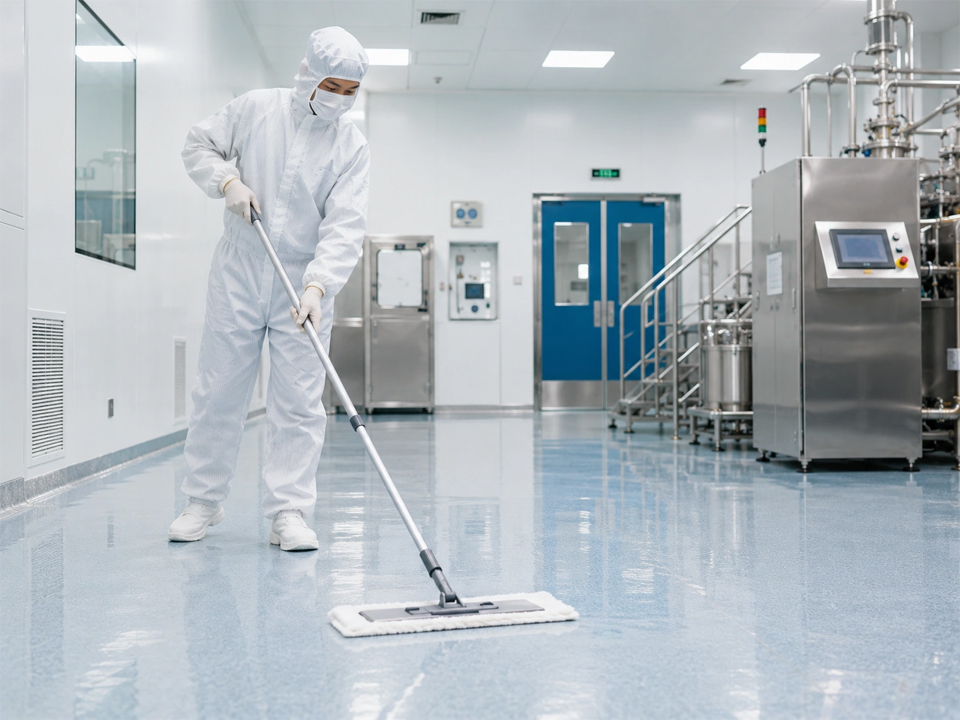
In electronics manufacturing, a cleanroom disposable is a single-use garment, accessory or cover (coverall, lab coat, cap, shoe cover, sleeve cover or bench cover) that is specified, packed and documented to limit contamination in a defined controlled area. “Contamination” covers three different problems, and each has its own control system:
Particles and fibers. The ISO 14644 series classifies cleanroom air by particle concentration. Garments and other consumables are assessed against the needs of the room and the process.
Electrostatic discharge (ESD). Static control on assembly lines is usually managed through an ESD control program, not through a cleanliness class.
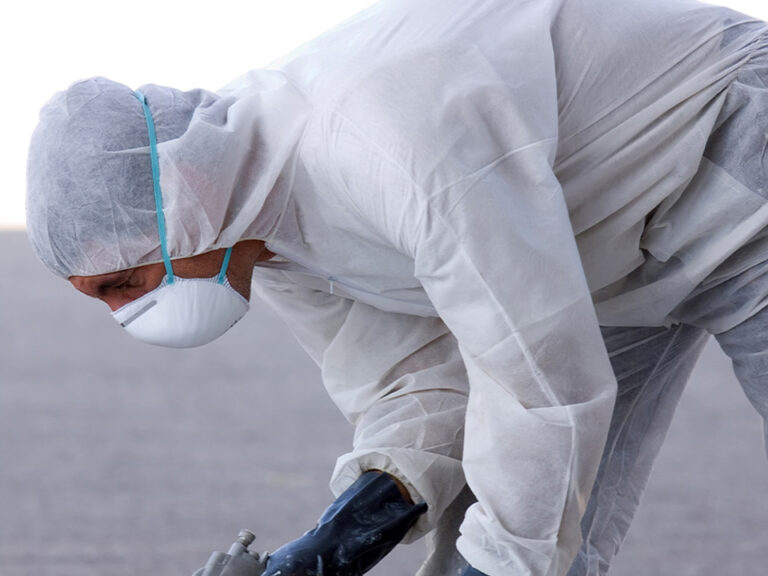
General site debris. Dust, abrasion and traffic in support areas have no cleanliness class, but they still determine garment durability and coverage.
The guidance in ISO 14644-18 on assessing the suitability of cleanroom consumables covers personal and non-personal consumables. It evaluates them against particles, chemicals and microorganisms, based on product and process requirements, and it describes both what the user should specify and what the supplier should document. In practice, the buyer writes the requirement and the supplier supplies the evidence. A “cleanroom grade” label on a product page does neither.
Static control works the same way. The ESD Association’s overview of ANSI/ESD S20.20 describes a program standard covering measures such as flooring, seating, packaging and personnel grounding, with the current version updated in 2021. A garment can support such a program. It cannot make a line compliant on its own.
Match the Disposable to the Zone, Not to the Label
Many electronics assembly lines are ESD-protected areas without an ISO particle classification. Many others combine both. The table below groups common zones by the risk that matters most. These are practical groupings for planning, not requirements taken from a standard, so confirm each against your own contamination-control and ESD plans.
Documented static behavior and test method, cuff-to-glove fit, low lint
Lab coat or smock, cap, anti-static shoe covers where your program allows
Support areas (receiving, warehouse, tooling storage, maintenance)
Dust, oil, handling debris, street clothing
Coverage, durability, size range, color coding
PP nonwoven coveralls or two-piece sets, aprons, sleeve covers
Construction, installation and commissioning sites
Dust, abrasion, vehicle and tool traffic
Visibility, tear resistance, keeping site debris out of the plant
Coveralls (high-visibility where vehicles operate), shoe covers
For gowning in classified rooms, the IEST-RP-CC003 garment system recommended practice provides nonmandatory guidance on selecting, specifying, maintaining and testing garments, including an appendix on garment configurations for different air cleanliness classes. Use it as a reference when writing the specification, not as a certificate a supplier can claim.
Four Specification Factors That Decide Suitability
Fabric Construction and Particle Release
Disposable garments use several fabric families. Spunbond PP is a single nonwoven layer. SMS combines spunbond and meltblown layers for a tighter barrier. Microporous fabrics laminate a breathable film onto a nonwoven, and PE garments are plastic film. Product pages in the range linked later in this article list PP, PP+PE, SMS, microporous and PE options at weights between 25 and 65 gsm.
Weight in gsm describes mass per area. It says something about strength and barrier, and very little about how many particles a garment releases. Two 60 gsm garments from different production lines can differ in fiber bonding, edge finishing and handling. What to verify:
Garment particle-generation test results, not only fabric specifications.
Seam type (sewn, taped or ultrasonically bonded) and whether cut edges are sealed.
Material and finish of zippers, cords, snaps and elastic.
Where the garment is made and packed, and whether processing is controlled.
The trade-off is wear time. Microporous and film fabrics generally breathe less than open nonwovens. If operators are uncomfortable, they loosen hoods and open cuffs, and gowning discipline suffers.
Static Behavior: “Anti-Static” Is Not the Same as ESD-Safe
Many disposable coveralls carry an anti-static pictogram. Lakeland’s technical fact sheet, Understanding Anti-Static in Limited Life Coveralls, explains what it means. The marking refers to EN 1149, a regime concerned with reducing sparks that could ignite flammable atmospheres. Under the most common test route, fabric must show a surface resistance of no more than 2.5 × 10⁹ ohms after conditioning at 25% relative humidity. The same document explains that disposable fabrics achieve this through a moisture-absorbing topical treatment, that such treatments can fade or rub off, that washing removes them, and that charge still needs a route to ground.
For electronics buyers, three consequences follow:
The marking was not written for ESD-sensitive devices. Your ESD coordinator needs data relevant to your own program.
Humidity affects performance. Topical treatments rely on moisture from the air, so dry-season conditions deserve attention.
Grounding is a program decision. As quoted in an ESD Association technical forum thread on S20.20 personnel grounding, when garments are used to achieve personnel grounding, this must be documented in the ESD control program plan, and the garments must meet the standard’s resistance requirements.
PE film and untreated PP are insulating plastics. Unless a supplier can document otherwise, treat them as barrier garments, not as part of your grounding system. What to verify: the test standard and report, the conditioning humidity, whether the garment is intended to be groundable, the shelf life of the treatment, and whether packaging is sealed. Then confirm incoming lots with your own verification routine.
Design Details Where Protection Fails
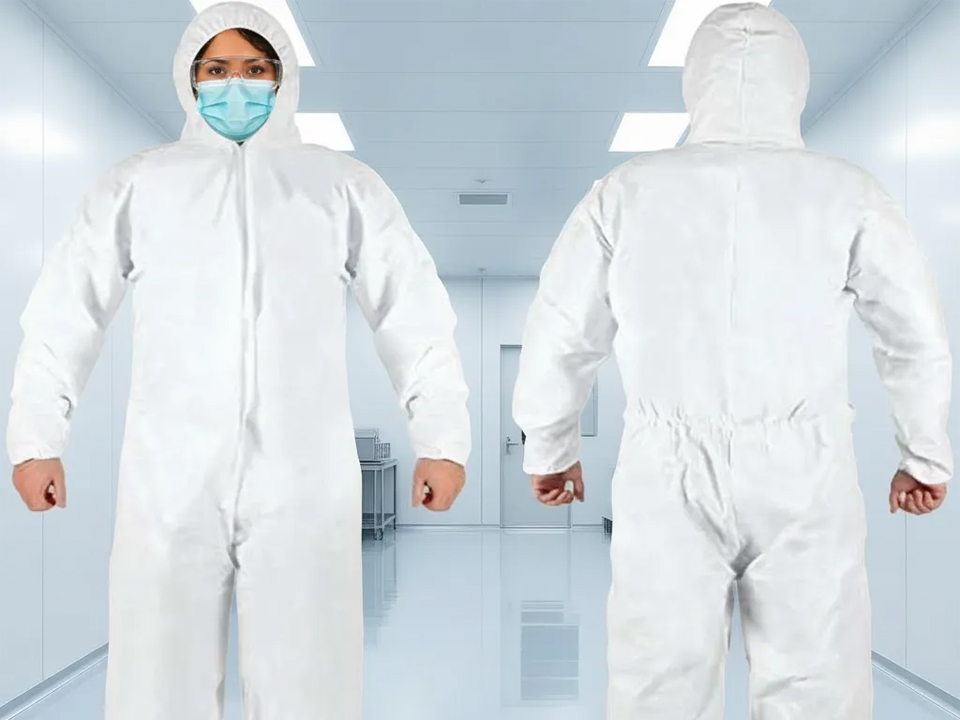
Contamination tends to escape at interfaces, not through fabric. Check hood-to-mask fit, cuff-to-glove overlap, ankle-to-shoe-cover overlap and the front closure. Product pages in the range show real choices: zippers with or without flaps, Velcro, snap or zipper fronts on lab coats, elastic or knitted cuffs, optional pockets, and single, double or knitted collars. Each affects coverage and donning speed. Pockets can collect debris, hard fasteners can become foreign objects on lines handling exposed boards, and two-piece sets can open at the waist when operators reach or bend. Ask which options are standard and which are special builds.
Packaging, Traceability and Storage
Packaging is part of the specification. Ask whether garments are packed one per bag or in multi-piece bags, whether cartons hold a single production lot, and what lot identification appears on the carton. The Lakeland fact sheet advises keeping garments sealed until use and preferring fully sealed bags where static performance matters. Store stock in a dry, clean area and rotate it, since treatment shelf life is rarely documented.
Which Garment Formats Suit Which Task?
The table summarizes five garment formats from the product pages reviewed for this article. The construction details come from those pages. The “best fit” and “check before using” columns are qualitative guidance. None of the pages, as retrieved, listed an ISO cleanliness class, a particle-release result or a surface-resistance value, so those must be requested.
Format
Construction listed on the product page
Best fit
Check before using in electronics
Two-piece hooded PP set (YF5002)
PP nonwoven, 40–65 gsm; elastic hood and cuffs; configurable waist, ankles and pockets; S–5XL
Support areas, warehouse, facility upkeep
Waist overlap; no static or particle data listed
Hooded coverall with blue taped seams (YF5003)
SMS or microporous, 50–65 gsm; front zipper with flap options; taped seams; M–5XL
Maintenance, dusty or liquid-exposed tasks
Cited EN 14126 covers infective agents, not electronics contamination
Reflective tape coverall (YF5004)
SMS or microporous, 50–65 gsm; elastic hood; front zipper, optional flap; reflective bands; M–5XL
Sites with forklift or vehicle traffic, contractors
Reflective bands add materials; keep to non-controlled zones
Configurable disposable lab coat (YF6001)
PP, PP+PE, SMS or microporous, 25–65 gsm; single, double, knitted or hooded collar; elastic or knitted cuffs; Velcro, snap or zipper
Line-side coverage, QA, visitors; ESD areas only with static data
PE, 25–55 g/pc; button front; open cuffs; S–XXXL or custom
Short-duration visits and low-risk dust-free tasks
Insulating film, open cuffs, no particle or static data listed
Coveralls for Support Areas and Sites
For support and facility work, the two-piece PP hooded workwear set lets buyers size jackets and trousers separately across S–5XL, which helps with a mixed workforce. The cost of that flexibility is the jacket-and-trouser overlap. Where dust, cleaning chemicals or liquid contact are more likely than static-sensitive handling, the hooded protective coverall with blue taped seams adds a front zipper and taped seam details in SMS or microporous fabric. Its page cites EN 14126, which addresses protective clothing against infective agents. That is an infection-control reference, so do not read it as evidence of electronics suitability.
On shared sites with forklifts or vehicle routes, a disposable reflective tape coverall with hood allows reflective bands on the arms, chest, waist, back and legs. Treat it as a site and logistics garment. Reflective tape is an added material, so confirm with your quality team before it enters any controlled area.
Lab Coats for the Line
On the line itself, a lab coat is often more practical than a coverall. It is usually faster to don and easier to inspect. The configurable disposable lab coat is offered in PP, PP+PE, SMS or microporous fabric with a choice of collars, knitted or elastic cuffs and three closure types. For static-sensitive work, discuss cuff style, closure material and treatment documentation first.
The clear disposable PE button-front lab coat lists electronics manufacturing and clean workshops among its intended uses. It also has open cuffs and a plastic film body, so it fits best as a short-duration cover for visitors or low-risk tasks until the supplier provides static and particle information for the intended zone.
Bench, Staging and Equipment Covers
Not every disposable on an electronics site is worn. During maintenance or fit-out, teams sometimes cover benches, staging tables or idle equipment. The nonwoven disposable flat bed sheets (70 × 180 cm, 90 × 100 cm or custom) and the disposable bed sheet rolls (50–80 cm widths on 150 m rolls) are positioned on their pages for clinics, spas and treatment tables. Using them in a plant is a buyer’s adaptation, not a listed application. They may serve as temporary dust covers in non-controlled areas. Do not use them on ISO-classified surfaces or ESD work surfaces without particle and static data. Cutting rolls at the point of use also creates cut edges and offcuts, which matters near exposed assemblies.
When Is a Lower-Spec Disposable the Better Choice?
A higher cleanliness tier is not automatically the better purchase. Cleanroom-processed, individually bagged garments cost more per piece, and in a warehouse or maintenance bay that extra cost removes no meaningful risk. Gowning compliance also counts. A comfortable, easy-to-fit garment that operators wear correctly can outperform a premium garment that is worn loosely.
The reverse also applies. In an ISO-classified room or an ESD-protected area, an inexpensive garment with unknown shedding or static behavior can introduce the defect it was bought to prevent. The ESD Association notes that static can lead to component failure, and some ESD damage can pass final test and surface later in the field.
The practical rule is to set specifications per zone and spend where product is exposed. For high-volume, demanding zones, also compare disposables with laundered reusable systems on a per-wear basis, including laundering, inspection and replacement. Disposables may win where volume is moderate or traceability is simpler. Reusable systems may win where gowning volume is high and the class is strict. Neither answer is universal.
Unit price also depends on fabric type, weight, any antistatic treatment, individual packaging, printing and the number of configuration options. Ask whether MOQ applies per variant, because collar, closure, color and packaging choices can each create a separate production setup.
How to Qualify Samples Before a Production Order
Run a short qualification routine before the first full order:
Inspect for loose fibers and edge finish. Check cut edges, seam ends and zipper tapes under good light.
Test fit with the full gowning set. Wear it with the mask, cap, gloves and shoe covers used in the zone, then bend, reach and sit.
Measure static behavior your way. Have your ESD coordinator test samples under your verification plan, at your typical humidity.
Run a particle check against your own baseline. Use whatever method your quality team already trusts, and compare with the garment you use today.
Confirm the production lot matches the sample. Check material, weight, packaging and labeling on the first shipment.
What Should Buyers Specify Before Requesting a Quote?
A precise RFQ avoids guesswork and reduces rework. Include:
Zone and cleanliness requirement. State the ISO class if one applies, or state that the area is an ESD-protected area with no particle class.
ESD requirement. Name your program standard, the test method you expect, the humidity condition and whether garments must be groundable.
Garment type and construction. Specify fabric family, weight range, collar, cuff, closure, pockets and seam preference.
Size and color plan. Provide the size distribution and any color-coding by department or zone.
Packaging. Specify units per bag, bags per carton, lot labeling and any printing.
Documentation. Request test reports, batch traceability and the stated shelf life of any treatment.
Commercial terms. Provide order quantity, MOQ per variant, delivery schedule, shipping method and sample quantity.
Send these details through the RFQ form on the product pages above, and ask for samples before committing to volume.
Frequently Asked Questions
What are cleanroom disposables for electronics assembly?
They are single-use garments, caps, shoe covers, sleeve covers and covers specified to limit particles, fibers or static in a controlled electronics area. Suitability depends on the zone, the supplier’s test data and packaging, not on a product label alone.
Are anti-static disposable coveralls the same as ESD-safe garments?
No. The anti-static marking on most disposable coveralls refers to EN 1149 surface-resistance testing, written around ignition risk. Electronics buyers should request data relevant to their own ESD control program and verify incoming lots themselves.
Does a higher gsm mean a cleaner disposable garment?
No. Gsm measures fabric mass per area and relates to strength and barrier. Particle release depends on fiber bonding, seams, edge finishing and handling, so ask for garment-level particle-generation test results instead of relying on weight.
Can PE disposable lab coats be used in ESD areas?
Only with documentation. PE is an insulating plastic film, so it should be treated as a barrier garment unless the supplier supplies static data for the intended use and your ESD coordinator approves it under your program.
Do all electronics assembly lines need ISO-classified cleanroom garments?
No. Many assembly lines are ESD-protected areas without an ISO particle class, and support areas need only durable, well-fitting garments. Define the requirement for each zone, and spend on higher cleanliness only where product is exposed.
What should I ask a supplier before ordering disposable garments for electronics use?
Ask for test reports on particle release and static behavior, the conditioning humidity used, seam and fastener materials, packaging format, lot traceability, treatment shelf life, MOQ per variant and sample availability before volume production.