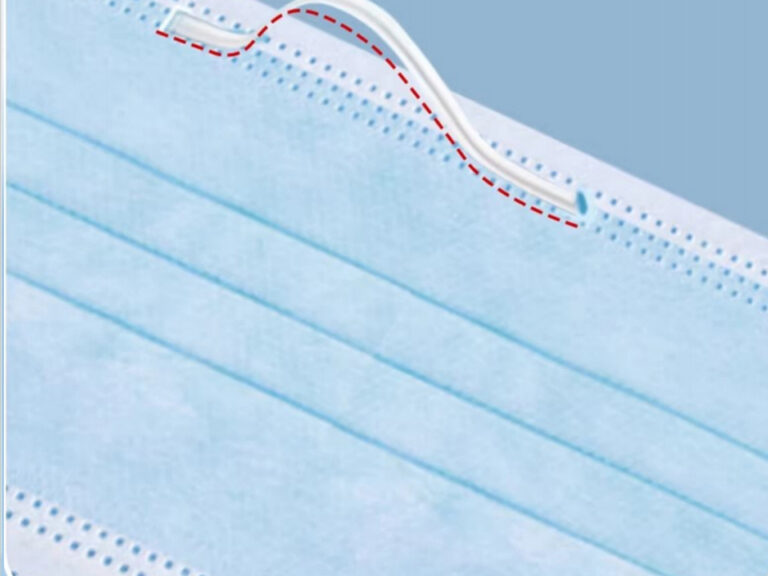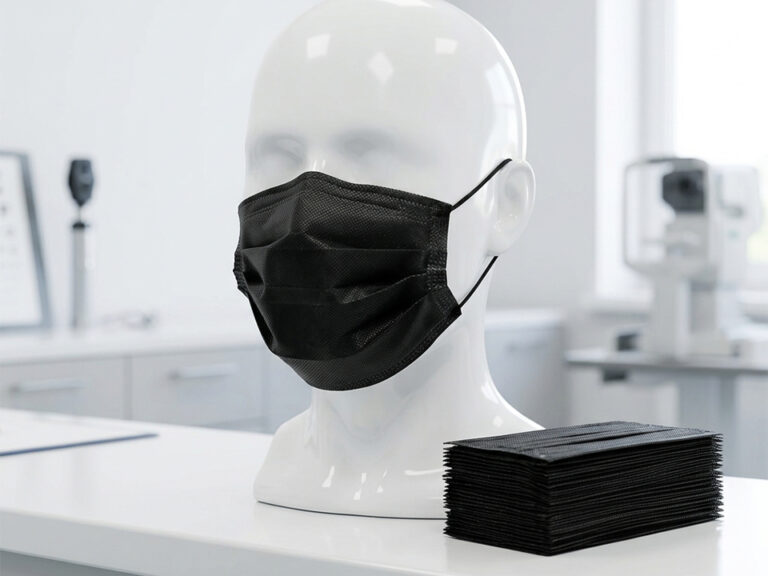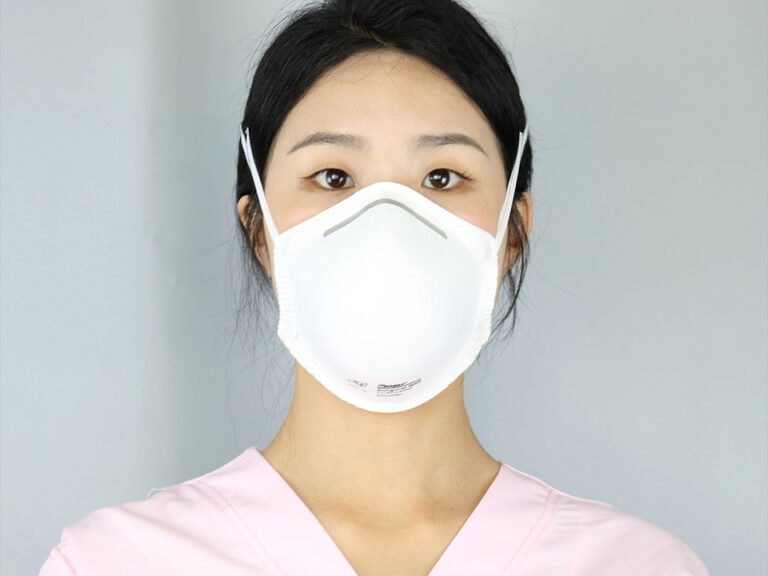


A 99% bacterial filtration efficiency number looks reassuring. It is also one of the easiest figures in medical-mask procurement to overread.
That number seduces.
Under ASTM F2101, however, BFE is a controlled comparison of bacteria-bearing aerosol counts upstream and downstream of a clamped material specimen, run under conditions that remove the loose ear loops, shifting nose wire, facial geometry, movement, speech, and hurried donning found in actual care.
So what, exactly, has the buyer learned?
The honest answer is narrower than most packaging suggests. Bacterial Filtration Efficiency can reveal whether tested mask material performs well against a defined biological aerosol. It cannot, by itself, establish wearer protection, face-seal performance, fluid resistance, breathability, production consistency, or effectiveness against every airborne particle.
I treat BFE as evidence. Never as a verdict.
What Does Bacterial Filtration Efficiency Mean?
Bacterial Filtration Efficiency is the percentage of bacteria-carrying aerosol droplets stopped by a mask-material specimen during a standardized laboratory challenge. The higher the result, the fewer viable bacteria-containing droplets were recovered downstream of the specimen.
The basic calculation is:
BFE (%) = 100 × (C − T) ÷ C
Here, C is the average bacterial count from the unfiltered positive controls, while T is the downstream count collected after the aerosol passes through the specimen.
If an unfiltered control produces 2,000 colony-forming units, or CFU, and only 20 CFU pass through the material, the calculated BFE is 99%. If two CFU pass through, it becomes 99.9%.
Simple arithmetic. Complicated meaning.
BFE can reveal three commercially useful things:
- Whether the tested material efficiently captures bacteria-bearing droplets under the reported conditions.
- Whether a medical mask appears capable of meeting the BFE threshold attached to a stated ASTM or EN classification.
- Whether repeated specimens produce reasonably consistent results rather than one suspiciously perfect number.
But BFE does not measure all air entering or leaving a worn mask. It does not measure the gaps beside the nose or cheeks. And it does not convert directly into a percentage reduction in infection risk.
That distinction is the spine of this article.
How ASTM F2101 Testing Produces a BFE Number
In ASTM F2101 testing, a laboratory generates an aerosol containing Staphylococcus aureus, directs it toward a secured mask specimen, and collects the aerosol that penetrates the material using a six-stage Andersen cascade impactor.
The challenge is commonly built around droplets with a mean particle size near 3.0 µm and a flow rate of 28.3 L/min. After collection, the agar plates are incubated and viable colonies are counted.
According to the FDA’s recognition record for ASTM F2101-23, the method measures the ratio between the upstream bacterial challenge and the downstream residual concentration. Its stated quantitative ceiling is 99.9%.
That ceiling matters. A result of “>99.9%” should trigger questions about the test method, challenge concentration, detection limit, and reporting convention—not instant applause.
The denominator matters greatly.
When positive-control counts are too low, poorly distributed, or omitted from the report, an impressive percentage can conceal a weak test challenge, leaving the buyer with polished arithmetic but little confidence in what the material actually faced.
How persuasive is 99.9% if nobody shows the underlying counts?
A useful ASTM F2101 report should identify:
- The exact test-method edition.
- The laboratory and its accreditation status.
- The mask brand, model, size, color, lot, and manufacturing date.
- Whether specimens came from finished masks or unconverted filter media.
- The challenge organism and strain.
- Mean particle size, airflow, conditioning, and control counts.
- Individual specimen results, not merely an average.
- Deviations from the standard method.
- The report date and authorized signatory.
I have a blunt rule: if a supplier displays a BFE percentage but withholds the full report, I treat the percentage as advertising.
Surgical Mask BFE Ratings: Why 95% and 98% Are Not the Whole Story
The familiar ASTM medical-mask matrix separates products into Levels 1, 2, and 3. Buyers often assume each level represents a progressively better bacterial filter. That is only partly true.
| ASTM mask level | Minimum BFE | Minimum PFE | Differential pressure | Synthetic-blood resistance |
|---|---|---|---|---|
| Level 1 | ≥95% | ≥95% | <5.0 mm H₂O/cm² | 80 mmHg |
| Level 2 | ≥98% | ≥98% | <6.0 mm H₂O/cm² | 120 mmHg |
| Level 3 | ≥98% | ≥98% | <6.0 mm H₂O/cm² | 160 mmHg |
These thresholds appear in FDA medical-mask performance documentation. Because standards are revised, every purchase order and test report should identify the edition being applied rather than relying on a generic “ASTM compliant” statement.
Here is the detail sales sheets tend to bury: Levels 2 and 3 share the same minimum BFE threshold of 98%. Level 3 principally raises the synthetic-blood resistance requirement from 120 to 160 mmHg.
So a Level 3 mask is not automatically a better bacterial filter than Level 2. It is specified for greater fluid-exposure resistance.
And 98% is not magically “medical grade” without the rest of the performance file. A mask could post strong BFE while failing breathability, particulate filtration, fluid resistance, biocompatibility, flammability, labeling, or production-control requirements.
The best BFE rating for medical masks is therefore the wrong opening question. The better question is: Which complete performance classification matches the intended procedure and exposure?
BFE vs PFE, VFE, Breathability, and Fluid Resistance
These measurements are related, but they are not interchangeable. I routinely see suppliers blend them into one vague promise about “filtration.” That is sloppy science and worse procurement.
| Test or property | Typical challenge | What it reveals | What it does not reveal |
|---|---|---|---|
| BFE | S. aureus carried in micrometer-scale aerosol droplets | Removal of bacteria-bearing droplets through tested material | Face leakage, wearer protection, submicron performance |
| PFE | Non-biological particles under a method-defined aerosol and size distribution | Material performance against smaller particles | Bacterial viability, fluid resistance, facial seal |
| VFE | Commonly bacteriophage Phi-X174 in aerosol droplets | Filtration of virus-containing test droplets | Protection against every virus or real clinical infection risk |
| Differential pressure, ΔP | Airflow across a defined material area | Breathing resistance through the material | Filtration through edge gaps |
| Synthetic-blood penetration | Approximately 2 mL projected at 80, 120, or 160 mmHg | Resistance to high-velocity fluid impact | Aerosol filtration or face fit |
| Fit or leakage assessment | A worn mask or respirator challenged around the complete face seal | Air bypass around the product | Intrinsic filter-media efficiency alone |
BFE vs PFE is not a contest over which acronym sounds safer. Particle size, aerosol composition, electrical charge, humidity, airflow, face velocity, and detection method can all alter the result.
VFE requires similar caution. A virus may be far smaller than a bacterium, yet respiratory viruses are often transported inside droplets or particles larger than the infectious agent itself. BFE can therefore correlate with VFE when the carrier-droplet sizes and test conditions are matched. It cannot justify a universal “blocks viruses” claim.
Three 2023–2024 Findings Buyers Should Not Ignore
A 2023 study found BFE and VFE moved together—but only under matched conditions
A May 2023 Scientific Reports study compared one medical mask and two community-mask categories using bacterial and viral bioaerosols. The researchers reported BFE results from 61.4% to 98.8%, VFE results from 65.5% to 99.2%, and a correlation coefficient of r = 0.983 for droplets in the 2–3 µm range.
That is meaningful evidence that droplet size can matter more than whether the droplet contains a bacterium or virus.
But the qualifier is everything: the relationship appeared under comparable experimental conditions and matched droplet sizes. It does not mean a 98% BFE label guarantees 98% filtration across all viral aerosols, particle sizes, flow rates, or wearing conditions.
A second 2023 study exposed the gap between filter efficiency and worn-mask efficiency
A June 2023 Scientific Reports investigation tested nine mask models on a mannequin while simulating breathing flows of 10, 60, 80, and 120 L/min. The researchers concluded that practically half of the air entering the system was not filtered across the tested intensities.
Read that again. A mask can contain high-performing material while a large share of air avoids that material.
The authors proposed “Real Bacterial Filtration Efficiency” as a way to adjust nominal material BFE for air leakage. Whether that proposed metric becomes widely adopted is secondary. The underlying warning is already useful: filter-media performance and whole-mask performance are different engineering problems.
A 2024 infected-person study showed what a strong seal can do
University of Maryland researchers compared masks worn by people with active COVID-19 during paired 30-minute sampling sessions. Their May 2024 report found that a duckbill N95 blocked 99% of large particles and 98% of small particles from escaping.
Other tested masks blocked at least 70%. The tested KN95 performed no better than cloth or surgical masks, which researchers attributed partly to leakage and poor facial conformity.
This was a source-control study, not a direct test of wearer protection. Still, it lands a hard punch: product category and filter claims cannot rescue weak fit.
I would not pretend these three protocols measure the same endpoint. They do not. Together, however, they show why professional buyers should stop treating BFE as a complete protection score.
Why High Medical Mask Filtration Efficiency Can Still Fail on a Face
Fit changes everything.
When breathing resistance rises, pleats collapse, the nose strip lifts, or ear loops pull asymmetrically, air follows the lower-resistance route around the mask edge, carrying particles past material that may have tested beautifully in a fixture.
Why would airflow politely obey the certificate?
Consider an intentionally simplified example. Suppose material captures 99% of the challenged droplets, but only 60% of total airflow passes through that material because 40% bypasses the edges. If the bypass captures nothing, the combined capture would be approximately:
0.60 × 0.99 = 59.4%
That is not a clinical protection estimate. It is a mass-balance illustration showing how leakage can dominate excellent filter performance.
Surgical masks are loose-fitting barriers. N95 filtering facepiece respirators are designed to seal and are evaluated under a different regulatory system. A surgical mask with 98% or 99% BFE does not become an N95, and a “surgical N95” must satisfy both surgical-mask requirements and NIOSH respirator requirements.
Hard truth: BFE measures what goes through the specimen. Real use also depends on what goes around it.

How to Audit a BFE Test for Medical Masks Before Sourcing
When I read a supplier dossier, I skip the oversized percentage and go directly to specimen identity. The report must connect the tested product to the product being quoted.
Use this seven-part audit:
- Match the identity. Confirm model number, dimensions, ear-loop or tie design, layer construction, color, packaging, and production lot.
- Name the standard. “BFE tested” is incomplete. Require ASTM F2101 or the applicable EN 14683 method, including the edition year.
- Verify the laboratory. Review ISO/IEC 17025 accreditation and confirm that the relevant test sits within the laboratory’s accredited scope.
- Inspect the raw conditions. Look for control counts, individual results, mean particle size, airflow, conditioning, and deviations.
- Demand the complete mask profile. Review BFE, PFE, differential pressure, synthetic-blood resistance, flammability, biocompatibility, microbial cleanliness where applicable, and labeling.
- Connect testing to production. One development sample is not proof of continuing lot performance. Require change control, incoming-material controls, in-process inspections, lot traceability, and defined retesting intervals.
- Control the claim contractually. Put the standard, level, test edition, acceptance criteria, lot documentation, and remedy for nonconformance into the purchase order.
Cross-category documentation is an underrated supplier test. In dental procurement, specifications for pure cotton dental rolls for wholesale healthcare supply should clearly identify fiber composition and absorbency, while paper and PE-film disposable dental bibs should document their layered barrier construction.
The same discipline applies in patient-care products. Buyers reviewing disposable absorbent underpads for healthcare wholesale or elastic-edge disposable absorbent bed covers should expect traceable materials, dimensions, absorption specifications, packaging details, and inspection criteria.
Those products do not prove mask performance. They reveal something else: whether the manufacturer treats technical specifications as controlled production requirements or as convenient marketing adjectives.
Frequently Asked Questions About Bacterial Filtration Efficiency
What does bacterial filtration efficiency mean?
Bacterial filtration efficiency is the percentage of bacteria-carrying aerosol droplets that a mask-material specimen stops under a defined laboratory challenge, usually using Staphylococcus aureus and a cascade impactor; it describes controlled filtration through the tested material, not the total protection a loose-fitting mask provides on a human face.
A higher BFE indicates less bacterial aerosol penetrated the specimen under those test conditions.
How do laboratories measure bacterial filtration efficiency?
Measuring bacterial filtration efficiency means challenging a clamped mask specimen with an aerosolized Staphylococcus aureus suspension, collecting droplets downstream in a six-stage Andersen cascade impactor, incubating and counting the colony-forming units, then comparing downstream counts with an unfiltered control to calculate the percentage removed.
The report should disclose the method edition, challenge conditions, controls, specimen identity, and individual results.
Is 99% BFE good for a medical mask?
A 99% BFE result is strong evidence that the tested material stopped nearly all bacteria-bearing droplets under the stated method, but it is not proof of 99% wearer protection because facial leakage, particle size, airflow, specimen conditioning, test edition, breathability, and correct donning can materially change real use.
Treat 99% as one strong data point inside a complete performance file.
What is the difference between BFE and PFE?
BFE and PFE are separate laboratory metrics: BFE measures removal of bacteria-bearing droplets, commonly around 3 µm, while PFE measures removal of non-biological particles under a different aerosol, particle-size distribution, flow, and calculation method; one result cannot be substituted for the other without matched protocols.
A credible medical-mask specification reports both when the governing classification requires them.
Does BFE show whether a mask protects against viruses?
BFE can support a limited inference about virus-bearing droplets when the droplet-size distribution and test conditions are comparable, but it does not measure free viruses, mask fit, inhalation leakage, infectious dose, or clinical infection risk, so it cannot establish that a medical mask offers equivalent protection to a fitted respirator.
Any antiviral claim should be checked against its exact test method and intended-use wording.
What is the best BFE rating for medical masks?
The best BFE rating for a medical mask is the rating that meets the intended task and governing standard: ASTM Level 1 commonly uses at least 95%, Levels 2 and 3 use at least 98%, and higher-risk aerosol exposure calls for a properly fitted, NIOSH-approved respirator rather than a higher BFE claim alone.
Level 3 primarily adds greater fluid resistance; it does not raise the minimum BFE above Level 2.
Turn BFE Evidence Into a Purchase-Order Requirement
Do not buy the percentage. Buy the documented process behind it.
Before approving a medical mask, require the full ASTM F2101 report, applicable ASTM F2100 or EN 14683 classification, laboratory accreditation scope, lot linkage, complete performance matrix, production samples, and written change-notification terms.
Send the supplier your destination market, intended procedure, required standard edition, fluid-exposure level, packaging format, monthly volume, and quality-document requirements. Then ask for evidence against every point.
A serious manufacturer will answer with traceable data.
Everyone else will send another 99% badge.